
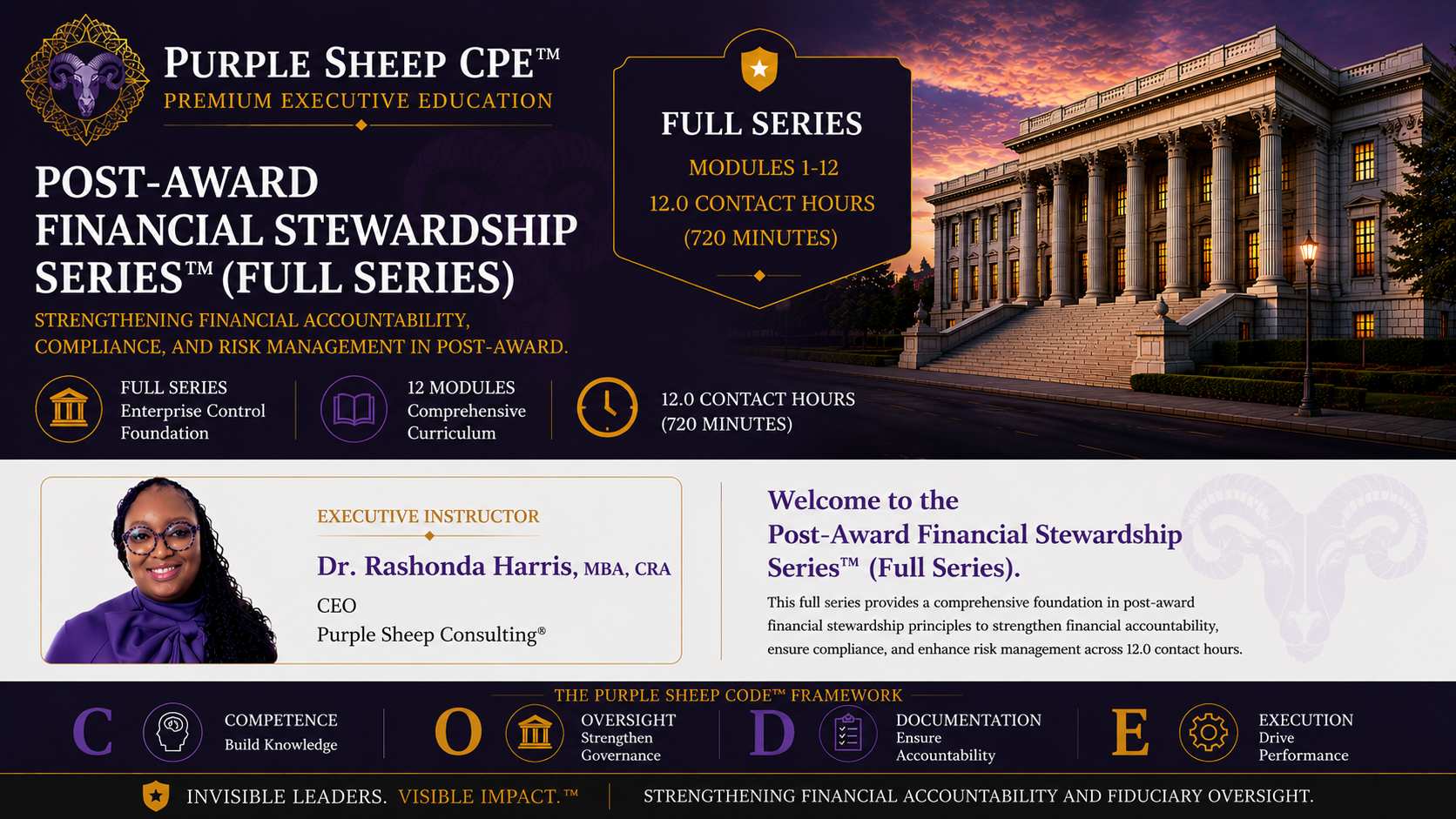
Post-Award Financial Stewardship Series™
Foundations Pathway (Modules 1-12)
12 Modules | 12 Contact Hours | Certificate Awarded | 180-Day Access
Strengthen Award Stewardship, Financial Oversight & Institutional Accountability
The Post-Award Financial Stewardship Series™ prepares research administrators, sponsored programs professionals, research finance personnel, compliance professionals, departmental administrators, principal investigators, and institutional leaders to strengthen financial stewardship, award accountability, compliance oversight, and institutional control systems across the post-award lifecycle.
This pathway provides a structured examination of the governance systems, financial controls, monitoring practices, documentation standards, and institutional decision-making responsibilities that support effective sponsored award management. Learners explore award stewardship, cost principles, financial monitoring, effort accountability, award modifications, closeout, indirect cost governance, high-risk costs, financial control failures, ERP governance, compliance remediation, and executive financial oversight.
Designed to move beyond transactional post-award administration, the series emphasizes institutional stewardship, fiduciary accountability, governance maturity, financial integrity, risk awareness, and enterprise-wide oversight of sponsored funding after award acceptance.
Grounded in the CODE™ Standard
The CODE™ Standard is the Purple Sheep Institute™s instructional framework for developing competent, accountable research professionals. This pathway applies the principles of Competence, Oversight, Documentation, and Execution through funding administration, stewardship, compliance, governance, and institutional accountability activities.
What You’ll Learn
Upon successful completion, learners will be able to:
- Strengthen institutional award stewardship and post-award financial accountability.
- Apply federal cost principles through governance-informed financial judgment.
- Evaluate financial monitoring systems, labor controls, and institutional oversight practices.
- Manage award modifications, closeout responsibilities, and documentation requirements.
- Assess indirect cost governance, high-risk cost categories, and enforcement trends.
- Analyze financial control failures and identify preventive institutional controls.
- Strengthen ERP governance, data integrity, and audit traceability.
- Translate financial and compliance risk into executive-level decision support.
Included Modules
Module 1
The Doctrine of Award Stewardship: Institutional Accountability Beyond Compliance
Establish the foundational doctrine of award stewardship and examine how institutional accountability extends beyond transactional compliance to encompass fiduciary oversight and governance responsibilities.
Module 2
Cost Principles as Control Systems: Interpreting Uniform Guidance in Practice
Examine how allowability, allocability, and reasonableness function as institutional control mechanisms that guide financial judgment under federal cost principles.
Module 3
Financial Monitoring Architecture: Building Active Oversight Systems
Explore the design of financial monitoring systems, including review cadence, variance analysis, burn-rate awareness, and early risk detection.
Module 4
Effort Certification & Labor Controls: Institutional Risk Points
Evaluate effort reporting, payroll distribution, documentation standards, and monitoring practices that strengthen labor-related financial controls.
Module 5
Award Modification Governance & Compliance Controls
Examine institutional responsibility for managing post-award changes to budgets, timelines, scope of work, personnel commitments, and subawards.
Module 6
Closeout as Control Verification: Institutional Integrity at Award Completion
Assess award closeout as a control verification stage that confirms reporting accuracy, financial reconciliation, documentation completeness, and audit readiness.
Module 7
Indirect Cost Governance & Institutional Rate Strategy
Evaluate facilities and administrative cost recovery, rate negotiation strategy, and institutional financial sustainability within sponsored program operations.
Module 8
High-Risk Cost Categories & Enforcement Trends
Analyze cost categories that frequently trigger enforcement actions or audit findings, including participant support, administrative salaries, equipment classification, and cost transfers.
Module 9
Financial Control Failures: Institutional Case Analysis
Use case-based analysis to examine financial control breakdowns, root causes, and preventive strategies that strengthen institutional oversight.
Module 10
Data Integrity & ERP Governance in Sponsored Programs
Examine enterprise system risks, ERP configuration, segregation of duties, data validation, and internal audit collaboration in sponsored programs management.
Module 11
Institutional Investigations & Compliance Remediation
Explore investigative procedures, voluntary disclosure considerations, corrective action planning, and remediation strategies when financial or compliance failures occur.
Module 12
Executive Financial Oversight: Translating Risk for Institutional Leadership
Develop executive reporting frameworks, governance dashboards, and decision-support communication strategies that translate financial and compliance risk for institutional leaders.
Who Should Enroll
- Research Administrators
- Sponsored Programs Professionals
- Post-Award Professionals
- Research Finance Professionals
- Research Compliance Professionals
- Departmental Administrators
- Grant and Contract Administrators
- Principal Investigators
- Internal Audit Professionals
- Research Leaders
- Institutional Decision-Makers
Credential Alignment & Professional Development
This pathway supports continuing education and professional development aligned with:
- Certified Research Administrator (CRA)
- Certified Pre-Award Research Administrator (CPRA)
- Certified Financial Research Administrator (CFRA)
- SOCRA Certified Clinical Research Professional (CCRP) Domains
- Association of Clinical Research Professionals (ACRP) Competencies
- Certified Internal Auditor (CIA) Principles
Learners remain responsible for determining how earned contact hours apply toward certification renewal, licensure, recertification, or professional development requirements.
CODE™ Alignment
Competence
Award stewardship, cost principles, financial monitoring, labor controls, ERP governance, and executive financial oversight.
Oversight
Post-award accountability, financial monitoring, risk detection, modification governance, compliance remediation, and institutional decision support.
Documentation
Award records, cost justifications, labor documentation, closeout support, ERP traceability, investigation records, and audit-defensible financial evidence.
Execution
Award stewardship, financial control implementation, compliance remediation, executive reporting, and sustainable post-award financial governance.
Completion Information
Contact Hours: 12
Certificate: Awarded Upon Successful Completion
Access Period: 180 Days
Course completion does not remove access during the enrollment period.
Certificates remain available throughout the active access period.
Continue Your Learning Journey
Expand your expertise through additional Purple Sheep Institute™ pathways focused on research administration, compliance, governance, financial stewardship, audit readiness, research leadership, and institutional accountability.
Explore complementary series, including:
- Institutional Funding & Proposal Development Series™
- Institutional Compliance & Control Systems Series™
- Facilities & Administrative (F&A) Rate Development Series™
- Research Security & Foreign Influence Series™
- Principal Investigator Leadership & Accountability Series™
Each series is designed to strengthen institutional capability through the CODE™ Standard and the Purple Sheep Institute™‘s governance-focused approach to professional education.
You must log in and have started this course to submit a review.